Semarang – The Central Java Provincial Government continues to accelerate the development of new and renewable energy (NRE) as part of its efforts to achieve the 2025–2030 regional energy mix target. However, amid significant developments in infrastructure and cross-sector collaboration, the challenges of funding and optimising the use of clean energy remain significant.
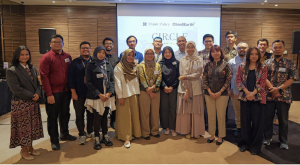
During the Renewable Energy Media Dialogue held by IESR on Wednesday, 26 November, the Central Java Energy and Mineral Resources Agency presented the current state of the electricity sector, developments in renewable energy, and the ongoing energy transition strategy.
Technical Reviewer of Renewable Energy Policy at the Central Java Energy and Mineral Resources Agency, Muhammad Rifqy Arya Marendra, explained that the province’s electrification ratio has reached 99.99%, exceeding the 2025 target. However, the dependence of the Java-Madura-Bali (JAMALI) system on non-renewable energy power plants means that efforts to increase the share of clean energy must be intensified.
The government noted that the development of renewable energy infrastructure in Central Java has so far been supported not only by the regional budget but also by the industrial sector, the private sector, and community self-help initiatives.
“Until the end of 2024, the realisation of the province’s NRE will continue to slow down as several programmes must be adjusted to budget efficiency,” said Rifqy.
Solar power plants and biogas are the main contributors
Data from the Ministry of Energy and Mineral Resources shows that as of September 2025, there were 866 rooftop solar power plants installed, both on-grid and off-grid, with a total capacity of 71,257 kWp. The largest contribution came from the industrial sector at 53,653 kWp, followed by commercial at 12,335 kWp, households, schools, and government buildings.
For biogas, utilisation reaches 11.38 million m³ per year, with digesters built throughout the region supported by the regional budget, village funds, private collaboration, and the community. Since 2007, more than 70 biogas units have been built under various schemes, and their use extends beyond cooking to lighting and organic fertiliser for residents’ farms.
In other sectors, the hybrid power plants resulting from Pertamina RU IV Cilacap’s CSR in Kampung Laut, Cilacap, is now used for lighting and local business development. The construction of solar power generators for Islamic boarding schools, MSMEs, and public facilities continues despite a decline in the number of installations, driven by budgetary efficiency.
Energy-independent villages are growing, boosting economy
The Central Java Provincial Government has recorded 165 villages as Energy Independent Villages, 28 villages in the Developing category, and 2,138 villages in the Initiative category. Through this programme, villages with renewable energy potential are encouraged to utilise biogas, solar power plants, solar-powered water pumps, biomass, and small-scale geothermal energy.
The programme has had a direct economic impact, particularly on villages that use renewable energy for rice-field irrigation, on commodity-drying businesses, and on reducing electricity costs for MSMEs.
A number of farmers in Tegal, Kebumen, and Purworejo have benefited from solar-powered water pumps that can irrigate dozens of hectares of land without relying on fuel.
The Central Java ESDM Office emphasises that the success of the energy transition cannot be achieved by the government alone. Collaboration with various parties continues to be expanded, including through a Memorandum of Understanding (MoU) with the Institute for Essential Services Reform (IESR), technical cooperation on biogas with the Rumah Energi Foundation, rooftop solar power plant training with PPSDM KEBTKE, and energy community assistance by students and youth organisations.
Diponegoro University is also involved in the Energy Independent Village study, while BBSP KEBTKE is researching the use of geothermal energy and biomass for productive community activities.
The media received special attention as a major player in combating misinformation and improving public understanding of renewable energy. Programmes such as Jelajah Energi (2022) and Ekspedisi Energi (2021) were cited for raising public awareness of the potential for clean energy in Central Java.
Meanwhile, the Central Java Provincial Government is also finalising revisions to the Regional Energy Master Plan (RUED) to align it with technological developments, national net-zero emissions (NZE) targets, the growth of electric vehicles, and the needs of green industries. Updating data on renewable energy potential, energy modelling, and academic papers are part of this revision process.
On the other hand, several challenges remain, such as budget constraints, industry dependence on captive electricity, public scepticism towards renewable energy, and misinformation. However, with improvements in renewable energy infrastructure, industry support, and cross-agency collaboration, Central Java is slowly shifting its energy foundation towards a cleaner energy system.
The government is optimistic that collaboration and innovation will maintain the pace of the province’s energy transition, although strengthening funding and accelerating infrastructure development remain urgent matters. (Hartatik)
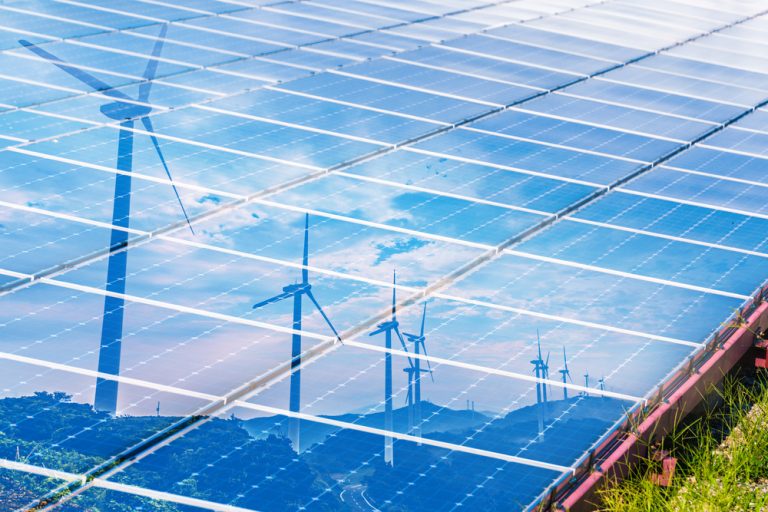
Banner photo: metamorworks/shutterstock.com