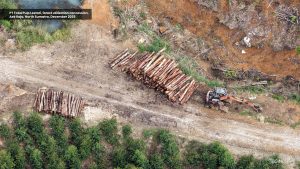
Jakarta – PT PLN Energi Primer Indonesia (PLN EPI) is accelerating its co-firing programme, which involves substituting coal with biomass at steam power plants (PLTU) throughout Indonesia. This subsidiary of PT PLN (Persero) has set a short-term target of using 2.5 million tonnes of biomass by the end of 2025, which is projected to reduce carbon emissions by up to 2.6 million tonnes of CO2e.
This target is part of the company’s grand roadmap to utilise 10 million tonnes of biomass by 2030. PLN EPI Bioenergy Director Hokkop Situngkir emphasised that this programme is one of the most powerful weapons for pursuing the Net Zero Emission (NZE) target because it can directly transform the fuel composition.
“Bioenergy is unique because its fossil molecules are replaced with biological molecules. In terms of life cycle assessment, it has been proven to significantly reduce carbon emissions,” said Hokkop in a discussion forum on the Prospects and Challenges of National Bioenergy held on Tuesday, 16 December.
Hokkop is optimistic that this figure can be achieved given Indonesia’s abundant bioenergy resources, which are estimated to reach 280 million tonnes per year. However, a major challenge remains as current absorption is only around 20 million tonnes. According to him, over the next 2–3 years, there is a potential of around 7.3 million tonnes of biomass that is already available and ready to be utilised in an accessible manner.
He also compared Indonesia’s potential with that of Brazil, which has successfully developed bioenergy on a massive scale. However, he emphasised that the key to the success of this transition lies in synergy between parties, which has so far been considered limited. “This is a wide-open opportunity, but there must be collaboration between all stakeholders,” Hokkop asserted.
In line with this, Milton Pakpahan, Chairman of the Indonesian Biomass Energy Society (MEBI), reminded that the need for biomass is not limited to the electricity sector. He highlighted the significant responsibility of co-firing and the plan to build a 0.9 GW Bioenergy Power Plant (PLT Bio) by 2034.
“You can imagine, 4.7 million tonnes in 5 years is a huge responsibility for co-firing. Please help PLN find a solution, a long-term solution,” said Milton. He also warned that the implementation of biomass must adhere to the principles of the circular economy by prioritising waste processing over the use of primary wood.
From an economic perspective, Imaduddin Abdullah, an economist at the Institute for Development of Economics and Finance (INDEF), sees bioenergy as having strategic value in driving the local economy through the involvement of upstream producers. However, he does not deny the existence of structural obstacles such as fragmented supply chains and price fluctuations.
“The movement of bioenergy indirectly impacts upstream producers, many of whom are part of the local economy. So we do see that this has a strategic role,” concluded Imaduddin. (Hartatik)
Banner photo: Martin Mecnarowski/shutterstock.com