by: Nopri Ismi and Finlan Aldan
This report is the result of collaborative reporting with the support of the Pulitzer Reporting Grant.
From Ecocide to Global Markets
The final part traces the consequences of illegal tin mining beyond Bangka’s scarred landscapes, linking local destruction to national policy failures and global supply chains. It shows how centuries of environmental damage have culminated in what activists describe as ongoing ecocide—devastating forests, rivers, coasts, and marine ecosystems—while tin extracted under illegal and exploitative conditions flows into international markets and everyday consumer products. By following the trail of permits, exports, and corporate buyers, this section asks who ultimately benefits from a system that leaves Bangka Belitung paying the highest price.
Tin exploration on Bangka Island has been going on since the 5th century AD. However, the environmental damage caused by mining began to be highlighted in the 19th century, as demand for tin increased due to the Industrial Revolution in Europe.
In 1850, to boost production, the colonial government adopted hydraulic mining technology from America. This technology used water cannons to destroy hills and extract tin quickly. Although highly effective, this technology caused severe environmental damage.
According to historian Corey Ross, in The Tin Frontier: Mining, Empire, and Environment in Southeast Asia, 1870s-1930s, the riverbed was raised by several metres, increasing the frequency of flooding and burying agricultural land with waste.
In fact, according to research by Erwiza Erman, reports by J.A. Schuurman (1898) and Karl Helbig (1940), a German geographer, cynically reported that “Bangka has many rivers but lacks clean water”.
Schuurman went on to explain that “no island in the archipelago has undergone such extraordinary topographical changes as a result of tin mining, which has stripped the soil extensively and deforested the land for hundreds of years”.
The use of water cannons also had a major impact on the ‘Orang Gunung’—the colonial nickname for the indigenous people of Bangka Island who live a semi-nomadic lifestyle, close to water sources and dependent on the forest for farming.
The colonial government forced them to settle in settlements far from the mining sites. This forced relocation was motivated by various reasons, including fears of rebellion, racist views, and ambitions to control natural resources and labour.
Over time, the Orang Gunung lost their rights to their customary lands. Ultimately, as Mary Somers wrote in Bangka Tin and Mentok Pepper in 1923, the Dutch declared that the indigenous people of Bangka had no ownership rights to their land and homes.
The situation worsened after the 1998 Indonesian reforms. Illegal mining exploded on Bangka Island. This was triggered by a number of national and regional policies that opened up opportunities for the community to get involved through the Unconventional Mining (TI) scheme.
The liberalisation of tin mining then opened the floodgates to various community groups, including capital owners (investors), suppliers of mining equipment and fuel, food vendors, entertainment providers, and miners from Bangka and elsewhere, who were able to reap both direct and indirect profits from the business.
Citing a study by Erwiza Erman, in 2001, there were an estimated 1,320 IT entrepreneurs with 4,671 individual IT owners scattered across the land and waters of Bangka. In May 2005, this number increased dramatically to 14,345 units. Meanwhile, according to a rough calculation by the Chairman of Astira (People’s Tin Mining Association), there are around 18,000 TI units.
Since then, the land of Bangka Island has been like ‘sugar’ that continues to be mined day after day. The term that best describes the destruction of Bangka Island was aptly coined by Corey Ross, an Australian historian, who in his research mentioned that dredging operations can damage the environment by covering fertile soil with dead sediment that they dredge from the water.
He believes that the landscape left behind by dredgers is permanently scarred by mounds and hills of sand.
“Thus, dredging is another form of ‘mass destruction’,” wrote Ross.
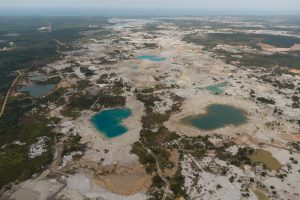
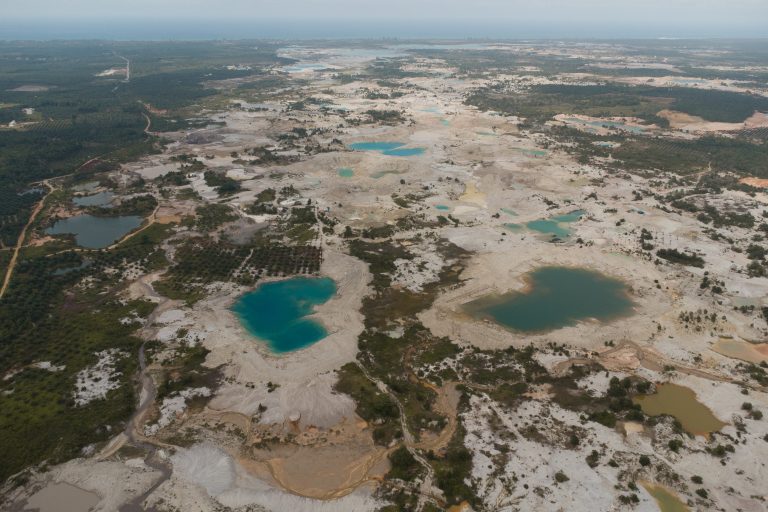
The traces of mass destruction described by Ross are still visible today. In 2021, there were 12,607 pits covering a total area of around 15,000 hectares spread across all regions of the Bangka Belitung Islands Province.
In less than six years (2014-2020), the Bangka Belitung Islands lost 460,000 hectares of forest. Only 197,255.2 hectares of forest remain, most of which is in conservation areas—the last home for the remaining wildlife in Bangka Belitung.
However, according to Langka Sani, founder of the Alobi Foundation, a non-governmental organisation that manages the Air Jangkang Animal Rescue Centre (PPS) in Bangka Regency, the release sites in Bangka Belitung have become very limited. The remaining forest ecosystems in the province have been infiltrated by mining.
Even nature conservation areas have been encroached upon. Take Gunung Maras National Park, for example. Although the hills are still green, the coastal area has been eroded by tin barges.
In addition, there is also the Gunung Menumbing Forest Park in Bangka Regency. This is the nature conservation area closest to the Alobi Foundation Air Jangkang PPS. However, Langka said that this location is no longer ideal for release due to the influx of miners entering the forest.
The conservation area that the Alobi team can still visit for release is the Gunung Menumbing Forest Park. The hills in the western part of this area have the strictest security compared to other conservation areas.
“There is a Forest Ranger Team on standby at the location and there is an Alobi team acting as Forest Ranger to provide security,” said Langka.
However, based on satellite image analysis, this area is also highly threatened by mining, particularly in its eastern part.
Two locations that have not been greatly affected by mining activities are Gunung Permisan Nature Park, with its hilly landscape, and Jering Menduyung Nature Park, with its mangrove landscape. However, unlike Gunung Menumbing, these two locations are still frequented by hunters.
“Animals can only function properly if they are in their natural habitat,” Langka Sani emphasised.
The damage caused by tin mining is not limited to land. The process of washing tin ore, which also carries mud from the mining process, flows downstream and ultimately causes siltation.
Tin mining activities are carried out in at least 202 watersheds out of the 433 watersheds in the Bangka Belitung Islands. There are around 196 watersheds awaiting restoration, while the rest are categorised as watersheds that must be preserved.
At the same time, a number of researchers and environmental activists continue to express concern about the destructive power of offshore tin mining. One study shows that dynamic ocean currents cause mining waste to continuously spread mud or sedimentation (TSS) over time.
The mangrove ecosystem, which is responsible for trapping sediment, has also been damaged. Walhi Bangka Belitung Islands recorded that around 240,467.98 hectares of mangroves have been damaged, leaving only 33,224.83 hectares in good condition.
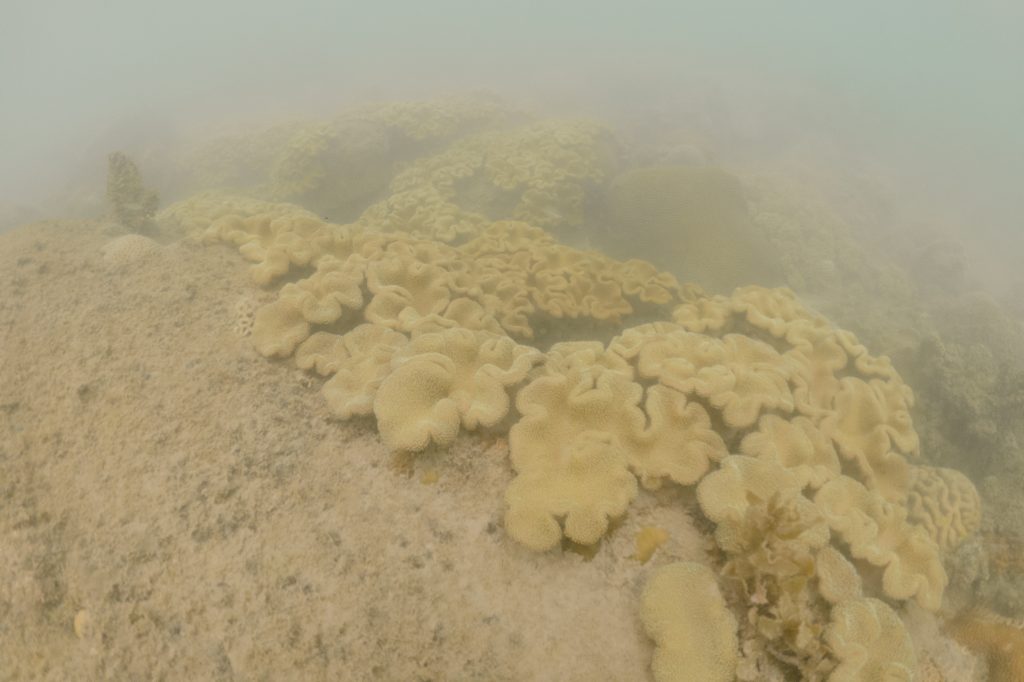
As a result, within 3-6 months, many waters in Bangka had exceeded safe limits for seawater due to this mud spread. The waste then covered the surface of the coral, inhibiting the process of photosynthesis.
“They [coral reefs] experience stress and starvation throughout the year, just waiting to die,” said M. Rizza Muftiadi, a coral reef researcher from the University of Bangka Belitung. “This is also what makes all reclamation activities futile as long as mining activities in the sea continue.”
According to Walhi Bangka Belitung Islands, the total area covered by land and sea mining permits is 915,854.625 hectares, consisting of 349,653.574 hectares of land mining permits and 566,201.08 hectares of sea mining permits.
Most of these IUPs will actually expire in 2025, including the IUP in the Bakit Sea where Linda works and the Kelabat Dalam Bay (Danta Sea), an area that Rustam and his colleagues have fought hard to protect.
However, based on the ESDM One Map, two mining permits in this area have been extended until 2026. Similarly, the Batu Beriga Sea, which is currently fighting to be free from mining permits, has also been extended until 2035.
In fact, the local government, through the Governor of Bangka Belitung Islands, had previously agreed to exempt the Batu Beriga Sea from tin mining permits. Ahmad Subhan Hafidz, Director of Walhi Bangka Belitung Islands, said that this violated the agreement.
The extension of dozens of mining permits on Bangka and Belitung islands by the government also demonstrates a lack of political will to stop the dirty practices inherent in the tin mining industry.
“The damage to forests, rivers, coastlines and seas that has been going on for hundreds of years is more than enough to declare that ecocide is taking place in Bangka Belitung,” Hafidz asserted.
Read the first part of this report.
Read the second part of this report.
Banner photo: Illegal tin mining operations are fragmenting the forest landscapes and river systems across Central Bangka Regency. These terrestrial mining activities frequently devastate critical ecosystems, particularly riverine corridors that harbor significant tin deposits. Photo by Nopri Ismi.
Update: Feb 6, 2026; 08.44: moving sponsor detail to top of article.
Feb 13, 2026; 10.54: deleted redundant paragraph, corrected the name “Ross”.