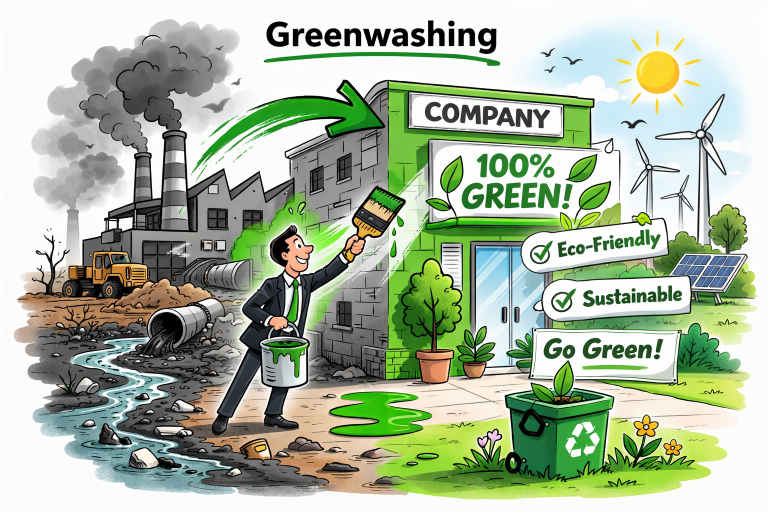
Greenwashing in the financial sector refers to misleading or deceptive claims about the environmental or climate benefits of financial products, investment strategies, or corporate actions. These practices, when left unchecked, distort markets, undermine investor confidence, and jeopardise efforts to align finance with global climate goals such as the Paris Agreement.
ClientEarth’s reports “Greenwashing and how to avoid it: An introductory guide for Asia’s finance industry” and “Guardrails to address greenwashing of climate transition finance” dissect the risks of greenwashing—especially in Asia’s fast-growing sustainable finance markets—and set out practical frameworks to address them.
Sustainable finance plays a pivotal role in directing capital toward activities and companies that contribute to climate mitigation and adaptation. However, greenwashing can impede this transition by creating a false impression of environmental performance, which can lead to capital being misallocated to entities that are not genuinely transitioning to low-carbon pathways. Misleading claims erode trust among investors and stakeholders and can have serious legal, financial and reputational consequences for financial institutions and corporates.
The guides highlight that regulators and international bodies are increasingly recognising greenwashing as a material issue, with legal enforcement actions and emerging regulatory standards being used to curb misleading claims.
Greenwashing can take many forms, including inflated sustainability claims for financial products without substantiated evidence; misleading product labelling, where investment funds or bonds are marketed as “green” without clear criteria; opaque disclosures that fail to provide transparent reporting on environmental impacts; and superficial commitments to climate goals that lack concrete plans and performance metrics.
Such practices can distort financial markets by making it difficult for investors to differentiate between genuinely sustainable investments and those that merely use eco-friendly language. This blurring inhibits the effective allocation of capital needed for the real-world climate transition.
The guides emphasise that although there is no universally agreed definition of greenwashing, regulators and standard-setting bodies globally are moving to curb misleading claims. Mechanisms such as the Task Force on Climate-related Financial Disclosures (TCFD) and standards from the International Sustainability Standards Board (ISSB) have emerged to set clearer reporting benchmarks. At the same time, national regulators in Asia, including those in China, Singapore, and Japan, are introducing sustainability disclosure requirements and product labelling guidelines aimed at increasing transparency and reducing greenwashing risk.
The guide also maps a typology of enforcement actions taken across the globe, illustrating how regulatory bodies and courts have acted against institutions or products deemed to have engaged in greenwashing. While these actions vary by jurisdiction, they show an expanding legal perimeter around environmental claims and indicate increasing scrutiny of financial actors.
To avoid greenwashing risks, the reports recommend a set of internal practices that financial institutions should adopt, including robust governance and internal processes for climate-related disclosures; verification of sustainability claims through reliable data and third-party review; regular engagement with portfolio companies to ensure that climate commitments are backed by credible transition plans; and clear, specific, and substantiated disclosures that align with evolving regulatory standards.
By integrating these practices into risk management and product design, financial institutions can improve transparency and uphold market integrity, thus reducing the risk of misleading investors or stakeholders.
Transition finance refers to the capital directed to high-emitting sectors to help them decarbonise over time, for example, through sustainability-linked bonds. These instruments have the potential to fund real-world emission reductions if they are aligned with science-based decarbonisation pathways. However, in the absence of clear regulatory guardrails, many labelled transition finance instruments are being issued to companies with weak or non-credible transition strategies. This erodes investor confidence and risks misallocation of capital, reducing the capacity of transition finance markets to facilitate a low-carbon transformation.
To counter this, ClientEarth proposes six key policy guardrails: national or regional Paris-aligned emission reduction pathways to guide corporate and investor strategies; scientifically robust classification standards for carbon-intensive activities and technologies, often embodied in taxonomies; market capacity for external verification to ensure objective assessment of transition finance claims; targeted financial regulation with mandatory thresholds for the use of protected transition finance labels; empowerment of financial regulators to enforce penalties on transition-washing; and systemic reforms to scale effective transition finance—not only labelled products—across sectors.
These policy measures are designed to bolster the credibility of transition finance markets and create a regulatory environment where only genuinely aligned instruments can carry transition labels. In doing so, they aim to incentivise firms with credible climate strategies while deterring superficial claims that dilute market integrity.
Together, the two reports paint a comprehensive picture of greenwashing and transition-washing challenges in the finance sector and outline a roadmap for regulators and market actors alike. They underscore that addressing greenwashing is not merely about semantics or marketing language—it is a systemic issue that affects the allocation of capital and the effectiveness of climate action.
For Asia, where sustainable finance markets are projected to grow rapidly, the need for strong regulatory frameworks, robust disclosure practices, and enhanced market discipline is particularly urgent. Without them, greenwashing could distort market signals, delay the real economy’s transition to net zero, and weaken investor trust. Conversely, by adopting the practices and policy recommendations outlined in these reports, financial institutions and policymakers can help ensure that finance meaningfully supports sustainability goals rather than merely appearing to do so.
You can access the guides here:
Greenwashing and how to avoid it: an introductory guide for Asia’s finance industry
Guardrails to address greenwashing of climate transition finance
This article is published in cooperation with ClientEarth. The views and opinions expressed are those of ClientEarth and do not necessarily reflect the views or editorial position of tanahair.net. https://www.clientearth.asia/
Banner photo: Image generated by OpenAI’s DALL·E via ChatGPT (2026)