Jakarta – Flash floods and landslides that hit North Sumatra have once again exposed major environmental management issues in the region. Eight districts/cities are now in ruins, with South Tapanuli and Central Tapanuli being the worst-affected areas. Thousands of houses have been washed away, tens of thousands of residents have been displaced, and agricultural land has been destroyed by the floodwaters.
This deadliest disaster occurred in an area known as the Harangan Tapanuli or Batang Toru Ecosystem, an essential tropical forest that plays a critical role in flood control, water absorption, and as a watershed for downstream areas. This ecosystem is spread across three districts: 66.7 per cent in North Tapanuli, 22.6 per cent in South Tapanuli, and 10.7 per cent in Central Tapanuli.
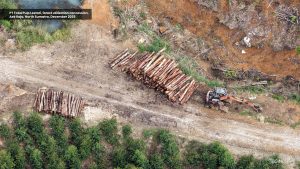
Environmental activists believe that the severe damage is not solely due to extreme weather, but rather the accumulation of spatial planning violations that have been ignored for years. They accuse the government, particularly the Ministry of Environment and the Ministry of Forestry, of being slow to respond to warnings about the damage to the Batang Toru area caused by large-scale mining and plantation activities.
CERI Executive Director Yusri Usman strongly criticised the government’s slow response.
“It is unfortunate that it took human casualties and property damage for the government, namely the Ministry of Environment, to take action. Regrettably, the relevant ministries were slow to respond to warnings that had long been voiced by the community about reckless policies in the mining and plantation sectors that violated regional and national spatial planning,” he said on Monday, 8 December.
Yusri also highlighted the weak enforcement of environmental laws to date.
“Before the Ministry of Environment was established, there was the Directorate General of Law Enforcement at the Ministry of Environment and Forestry, but it was powerless in cracking down on violations related to the environment and forest areas,” he said.
The Indonesian Forum for the Environment (WALHI) North Sumatra reinforced this criticism. They named seven companies as the most likely contributors to ecological damage in the Tapanuli region. These companies include gold mines, hydroelectric power plants, micro-hydro power plants, geothermal power plants, and two large plantation companies that control palm oil plantations.
One of them is PT Agincourt Resources, the operator of the Martabe gold mine, which Yusri suspects of conducting problematic activities in sensitive zones.
Growing public pressure finally prompted the government to take decisive action. The Ministry of Environment/Environmental Control Agency (KLH/BPLH) ordered the temporary suspension of operations at three companies: PT Agincourt Resources, PTPN III Batang Toru Estate, and PT North Sumatera Hydro Energy (NSHE), the developer of the Batang Toru hydroelectric power plant.
The Minister of Environment/Head of BPLH, Hanif Faisol Nurofiq, emphasised that the decision was an emergency measure to alleviate ecological pressure upstream of the watershed, which plays a vital role for millions of residents in North Sumatra.
“Starting 6 December 2025, all companies upstream of the Batang Toru watershed must cease operations and undergo environmental audits. We have summoned the three companies for an official inspection on 8 December 2025 in Jakarta. The Batang Toru and Garoga watersheds are strategic areas with ecological and social functions that cannot be compromised,” he said on Saturday, 6 December.
The environmental audit will determine the direction of further legal action, including the possibility of permanent suspension or revocation of business licences if serious violations are found. However, for residents and environmental activists, the big question that remains is why this action was only taken after casualties had been suffered.
The disaster in North Sumatra serves as a stark warning about how spatial planning violations, uncontrolled exploitation of natural resources, and weak supervision can lead to ecological damage that culminates in humanitarian disasters. The central government is now under public pressure to take action before the next tragedy occurs. (Hartatik)
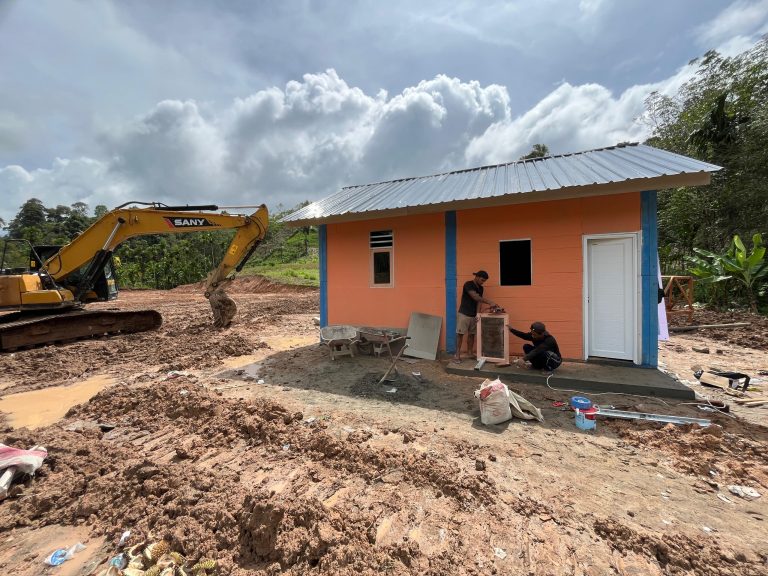
Banner photo: Temporary shelters in Adiankoting Subdistrict, North Tapanuli, on Sunday, 21 December 2025. Source: BNPB