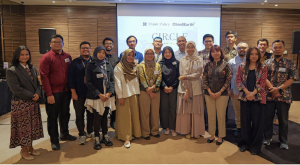
Semarang – The Institute for Essential Services Reform (IESR) assesses that the potential for renewable energy (RE) in Central Java remains far from optimal, even as electricity demand continues to grow. IESR states that the current electricity system in Central Java is heavily reliant on fossil-fuel power plants, while renewable energy is expected to contribute only 18.55% in 2024, below the provincial target of 21.32% in 2025. These findings were presented at a Media Dialogue with the Central Java Provincial Government on “Renewable Energy Development and Targets” on 26 November 2025 at Somerset Semarang.
IESR emphasises that, with electricity growth exceeding 5% per annum over the past four years, accelerating the utilisation of renewable energy is not only a climate necessity but also an economic necessity for the region.
In his presentation, IESR Geographic Information System Analyst Sodi Zakiy M said that Central Java’s electricity system has a reserve capacity of up to 6.3 GW, exceeding the peak load of only 5.6 GW. However, 96.6% of operating power plant capacity comes from fossil fuels, mainly coal-fired and gas-fired power plants.
“The contribution of new renewable energy sources has reached 432 MW, and most of it comes from geothermal, hydro, and rooftop solar power plants,” explained Sodi.
This dependence is considered an obstacle to regions entering the green economy ecosystem, especially as large industries begin to demand low-carbon energy as a global investment standard.
Renewable energy potential is abundant, but realisation remains low
Central Java has considerable renewable energy reserves. IESR data shows that the available technical potential includes 194.28 GWp of solar energy, 29.5 GW of wind energy, 730 MW of hydro/micro-hydro power, 105.9 MW of biomass energy and >1,200 MW of geothermal energy. However, the actual utilisation is very low, with only 55 MW of solar power plants installed, biomass not yet widely utilised, and wind power not installed at all.
Meanwhile, in the 2025–2034 RUPTL, PLN has prepared two scenarios for adding renewable energy power plants, namely the RE Base scenario, which targets the addition of 1,237 MW of solar power plants, 171 MW of hydroelectric power plants, and 162 MW of geothermal power plants, and the ARED (more aggressive) scenario, which plans to expand solar power plants by 7,321 MW, hydroelectric power plants by 342 MW, and geothermal power plants by 1,724 MW.
Based on a 2025 financial study, IESR identified 16 locations for renewable energy power plants that are feasible for further development. These consist of 12 ground-mounted solar power plants (total 13.4 GWp), two wind power plants (160 MW) in Pemalang and Wonogiri, and two hydroelectric power plants (4.8 MW) in Cilacap.
Based on IESR’s analysis, accelerating renewable energy development in Central Java requires structural changes, particularly in licensing and spatial planning. Several key recommendations were put forward, including the need for land allocation in the Regional Spatial Plan (RTRW) for renewable energy installations; land acquisition must be faster and based on OSS data; local governments need to prioritise projects with high returns on investment; and interconnection to the PLN grid must be simplified, especially for large-scale solar power plants.
IESR also emphasises the importance of innovative financing, including blended finance schemes and cooperation with the private sector, given the limitations of the regional budget. With electricity demand growing at 4.4%–5% per annum and global pressure to decarbonise manufacturing, Central Java is seen as a province that must move quickly in its energy transition. (Hartatik)
Banner photo: FotoIdee/shutterstock.com