Jakarta — The Institute for Essential Services Reform (IESR) assesses that the performance of the Ministry of Energy and Mineral Resources (MEMR) throughout 2025 has not shown any significant improvement. Instead of strengthening the energy transition, various indicators reflect a continued high dependence on fossil fuels and weak efforts to strengthen national energy security.
IESR Chief Executive Officer (CEO) Fabby Tumiwa said on Saturday, 10 January, that the achievements reported by the government need to be viewed critically as they do not fully reflect the structural progress of the energy sector.
“In general, the performance of the Ministry of Energy and Mineral Resources in 2025 shows disappointing results and has not addressed the challenges of Indonesia’s energy transition and energy security,” said Fabby.
The Ministry of Energy and Mineral Resources reported that the average lifting of petroleum, including Natural Gas Liquid (NGL), throughout 2025 will reach 605.3 thousand barrels per day (bpd), slightly above the 2025 State Budget target of 605 thousand bpd. This figure is an increase compared to the 2024 realisation, which was around 579.7 thousand bpd.
However, according to IESR, this achievement is misleading because the 2025 oil lifting target itself is much lower than the 2024 target of 635 thousand barrels per day (bpd).
“Although it is reported to be slightly above target, the 2025 oil lifting target is very low and has continued to decline since 2020. Compared to 2020, the oil lifting target has fallen by around 14.4 per cent,” said Fabby.
IESR also highlighted the lifting calculation method that includes NGL. According to Fabby, NGL has different characteristics from petroleum.
“If NGL is not included, it is highly likely that actual oil lifting will not reach the target. This can be seen from the difference in data between the Ministry of Energy and Mineral Resources and SKK Migas in the first half of 2025,” he said.
Under these conditions, the production target of 1 million bpd by 2030 is considered increasingly difficult to achieve. Meanwhile, imports of crude oil and fuel remain at around 1 million bpd.
Renewable energy is far from the target
On the renewable energy side, the Ministry of Energy and Mineral Resources notes a cumulative installed capacity of around 7 GW in 2025 and a renewable energy mix of 15.75 per cent, up from 14.65 per cent in 2024.
IESR considers this achievement to be far from the target. Throughout 2025, the addition of renewable energy capacity will only be around 1.3 GW from a total installed capacity of 14.3 GW in 2024.
“The renewable energy mix for the electricity sector is still below the revised National Energy Policy target. Even the largest claimed increase is largely supported by rooftop solar power plants installed by consumers, not projects planned in PLN’s RUPTL,” said Fabby.
Based on the Indonesia Energy Transition Outlook (IETO) 2026 study, Fabby explained that the increase in renewable energy will greatly determine the direction of Indonesia’s emissions and economic growth.
“In a scenario without additional efforts, greenhouse gas emissions will continue to increase and could reach more than 1,100 MtCO2e by 2060. Conversely, with extra efforts and a renewable energy mix of up to 77 per cent, emissions could be reduced to around 436 MtCO2e with continued high economic growth,” he explained.
The Ministry of Energy and Mineral Resources recorded the realisation of investment in new and renewable energy and energy conservation (EBTKE) amounting to USD 2.4 billion in 2025, exceeding the target of USD 1.5 billion. However, the investment target has been lowered compared to 2024.
According to IESR, this achievement does not yet reflect the attractiveness of Indonesia’s renewable energy sector.
“Globally, clean energy investment will reach USD 2.1 trillion by 2024, far exceeding fossil fuel investment. Indonesia is still lagging and needs around USD 30–40 billion per year in investment to reach peak emissions by 2030 and net-zero emissions by 2050,” said Fabby.
He also emphasised the importance of developing the domestic renewable energy industry and clean technology.
“Indonesia cannot continue to rely on imports of solar panels and batteries. Strengthening the domestic industry will increase energy security, absorb labour, and drive economic growth,” he said.
Coal production continues to exceed target
National coal production in 2025 is projected to reach 790 million tonnes, exceeding the target of 739.6 million tonnes. For 2026, the government has set a production target of around 600 million tonnes.
IESR considers that this situation indicates that fossil fuels still dominate the energy sector.
“Since 2020, coal production has consistently exceeded targets, driven by exports and dependence on state revenue. This signals weak production control discipline,” said Fabby.
IESR also warned of the risk of falling coal prices on state revenues and fiscal stability.
“The government needs to prepare scenarios if coal prices continue to fall, including the risk of stranded assets and debt defaults in the financial sector,” he said.
The Ministry of Energy and Mineral Resources claims that the mandatory B40 biodiesel policy has succeeded in reducing diesel imports to around 5 million tonnes by 2025.
However, IESR asked the government to carefully consider the use of crude palm oil (CPO).
“CPO is not only for biofuel, but also for food, industry and export. If its use for biofuel continues to increase while production stagnates, there will be pressure on supply and state revenue,” said Fabby.
He emphasised that the risk of a decline in CPO exports should not be used as an excuse to open up new palm oil plantations.
“Deforestation actually depletes carbon reserves and exacerbates the climate crisis,” he said.
IESR encourages the government to seek alternative feedstocks for biofuels and accelerate vehicle electrification to reduce demand for fossil fuels.
Village electricity access needs quality, not just quantity
The village electricity programme in 2025 has reached around 77,616 customers in 1,516 locations. Although appreciated, IESR considers that the quality of electricity access in 3T areas is still uneven.
“Many villages still do not have access to 24-hour electricity with adequate power. Improving access should focus on reliable and sustainable renewable energy solutions,” said Fabby.
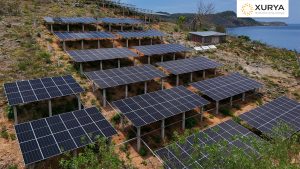
IESR recommends the use of modular solar power plants equipped with batteries and decentralised management through cooperatives or village-owned enterprises.
“Without capacity building and governance, decentralisation will only shift problems from the centre to the regions and cause village electricity projects to be neglected,” she concluded. (Hartatik)
Banner photo: Image generated by OpenAI’s DALL·E via ChatGPT (2024)