Jakarta — The priority phase of Indonesia’s 100 gigawatt (GW) solar power program could require up to USD 78 billion over the next five years, according to the Institute for Essential Services Reform (IESR).
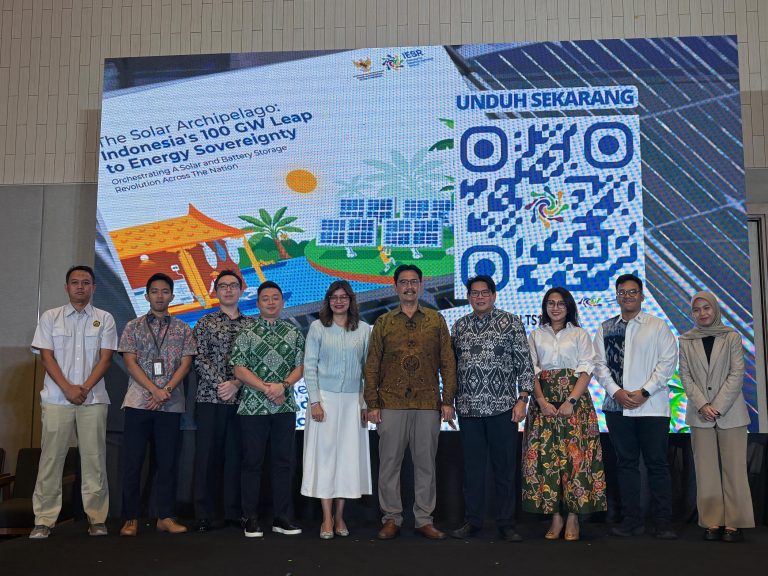
The estimate was presented on Monday, February 23, at the launch of a report titled “The Solar Archipelago: Indonesia’s 100 GW Leap to Energy Sovereignty”, published by IESR in collaboration with the Coordinating Ministry for Economic Affairs. The report serves as a policy and implementation roadmap for developing 100 GW of solar power capacity nationwide, providing a framework to carry out President Prabowo Subianto’s directive to accelerate large-scale solar deployment.
The study outlines a detailed strategy for deploying solar photovoltaic (PV) power plants integrated with Battery Energy Storage Systems (BESS). It proposes accelerating the phase-out of high-cost diesel power plants in line with PLN’s Electricity Supply Business Plan (RUPTL), while expanding village-scale solar systems to support local economic activities, including cooperatives, cold storage facilities, and micro, small, and medium enterprises.
Sunandar, Assistant Deputy for Electricity and Geology Development at the Coordinating Ministry for Economic Affairs, stated that the initiative could strengthen domestic industries by creating market certainty for solar manufacturing and supply chains, while generating employment opportunities.
IESR Chief Executive Officer Fabby Tumiwa said Indonesia has a strategic opportunity to transition from a fossil fuel-dependent economy to a leader in renewable energy in Southeast Asia.
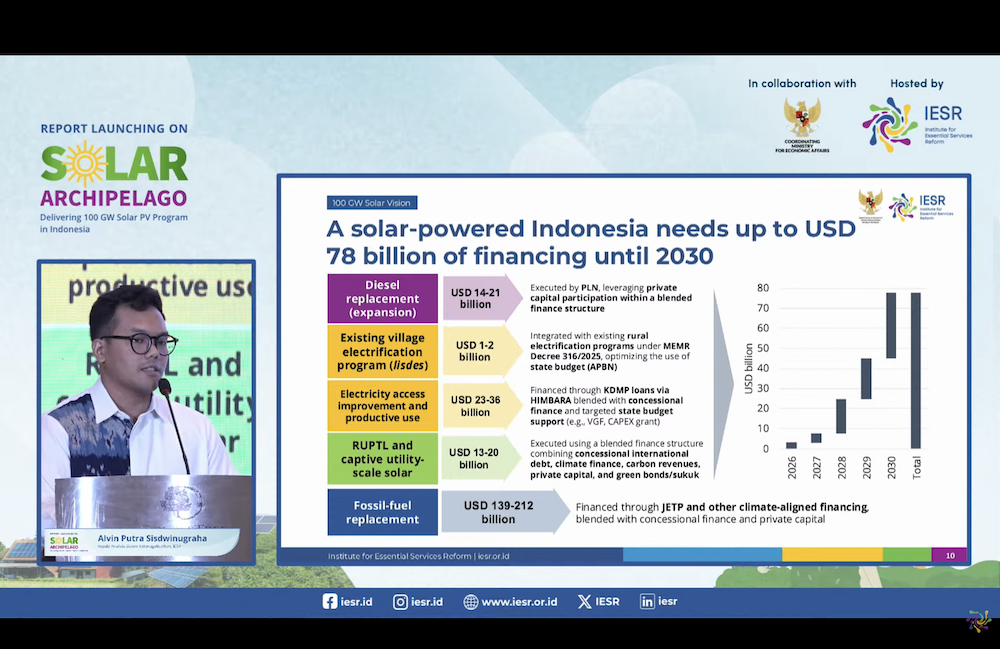
Alvin Putra Sisdwinugraha, Head of Energy System Modelling and Analysis at IESR, said a significant portion of the USD 78 billion required during the priority phase through 2030 would go toward replacing high-cost diesel power plants, a program to be executed by PLN. Existing village electrification (Lisdes) projects would continue to rely on the state budget (APBN), in line with Energy and Mineral Resources Ministry Decree No. 316/2025 on rural electrification.
However, expanding the program beyond current allocations will require stronger private sector participation and closer inter-ministerial coordination. For projects included in PLN’s RUPTL, Alvin said a blended financing structure is necessary to attract broader investment.
Beyond the initial USD 78 billion priority phase, IESR estimates that a more aggressive fossil fuel replacement strategy could require at least USD 139 billion. While the figure appears substantial, Alvin said it remains feasible if Indonesia optimises access to international climate finance.
IESR projects that the full 100 GW initiative could create approximately 118,000 green jobs, reduce fuel subsidies by up to Rp21 trillion, and cut greenhouse gas emissions by up to 24 million tons of CO₂ equivalent.
The organisation also called for revisions to PLN’s RUPTL to align with Indonesia’s energy transition targets, including accelerating the retirement of ageing coal-fired power plants and preventing future fossil-based overcapacity. (nsh)
Banner photo: Launch of a report titled “The Solar Archipelago: Indonesia’s 100 GW Leap to Energy Sovereignty”, published by IESR in collaboration with the Coordinating Ministry for Economic Affairs. February 23, 2026. (Source: IESR)