Jakarta – After the UN Climate Conference (COP30) in Belém failed to produce a firm decision on phasing out fossil fuels, attention is now turning to Indonesia’s ability to uphold its own climate commitments. Researchers and environmental organisations warn that weak accountability and governance of climate action domestically could see Indonesia’s promises on the international stage remain nothing more than rhetoric.
Climate Action Senior Lead at the World Resources Institute (WRI), Wira A. Swadana, on Friday, 5 December, strongly criticised the results of the COP30 negotiations, which aimed to focus on the energy transition agenda. “In the ‘Global Mutirão’ text, there are no phrases related to energy transition, such as directives on the fossil fuel phase. There is no roadmap, and it is still voluntary, so it is not binding for the commitment to phase out fossil fuels, which is also unclear,” he said.
The final document of COP30, “Global Mutirão”, does not contain explicit directives to stop the use of fossil fuels. The absence of a binding roadmap is considered to reflect the fragility of countries’ commitments to their Nationally Determined Contribution (NDC) targets, including Indonesia.
According to Wira, this weak global commitment is also reflected in the lack of support for the Belém Declaration on a just energy transition. Only 24 countries affected by climate change have signed it, falling far short of expectations to exert stronger international pressure on the largest fossil fuel producers and consumers.
He warned that this situation could have a direct impact on Indonesia, particularly in terms of access to funding through energy transition mechanisms such as the Just Transition Mechanism. Weak international support could shift the burden to countries such as Indonesia, which are still dependent on coal.
Domestically, researchers consider accountability gaps to be far more worrying. Riko Wahyudi, a researcher at the Research Centre for Climate Change (RCCC) at the University of Indonesia, emphasises that Indonesia’s climate achievements to date do not paint a stable picture of success in reducing emissions.
“Indonesia’s success in maintaining emissions below the baseline NDC for the previous period cannot be separated from the decline in economic activity during the Covid-19 pandemic. However, national emissions immediately rose and have already approached the baseline since the pandemic ended,” he said.
Riko believes that the root of the problem lies in climate governance, which does not yet cover all actions measurably. Currently, only actions included in the NDC document undergo the measurement, reporting and verification (MRV) mechanism. Even this process is not yet uniform across sectors because there is no clear sectoral mandate.
“Indonesia’s NDC coverage could be broader, but if the sectoral mandate is unclear, it will remain problematic,” he said.
He also warned that any failure to achieve national emission targets could have fatal consequences for Indonesia’s position in international carbon trading under Article 6 of the Paris Agreement.
“We must not be active in international mechanisms such as carbon trading (Article 6), but fail to achieve our NDC targets by 2030. It would be ridiculous to sell our targets but not reduce emissions. Then we would have to pay even more,” he said.
This situation puts Indonesia in a critical position. Global pressure on coal will only increase after COP30, but national commitments lack a foundation of accountability, institutions and robust reporting systems.
Riko emphasised that Indonesia needs a clear, comprehensive energy transition roadmap based on strong political commitment.
“If this NDC is not achieved, let alone a net sink in the FOLU (forestry and other land use) sector, even net zero is still uncertain. For this reason, in the energy sector going forward, political will is important; the roadmap must be comprehensive and inclusive, safeguards that integrate GEDSI must also be established, and energy transition efforts must also be implemented. Don’t just pay lip service,” he said.
With global uncertainty following COP30 and domestic vulnerabilities in terms of accountability, experts believe Indonesia must now move quickly. Without improvements in governance, there are concerns that Indonesia’s climate commitments will remain nothing more than a list of unfulfilled promises, while the impact of the climate crisis worsens year after year. (Hartatik)
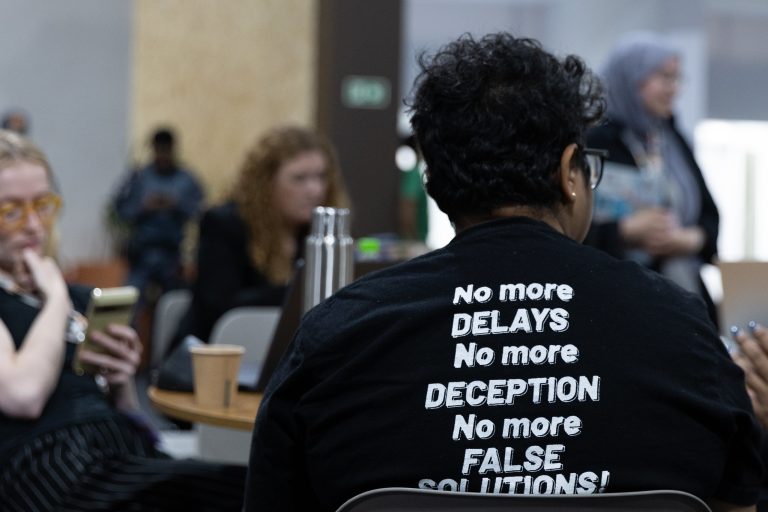
Banner photo: Delegates speak informally before the start of UNFCCC COP30 closing plenary (Photo: © UN Climate Change – Kiara Worth)