Jakarta – Mud pits, lost villages, and millions of residents now displaced from Aceh to North Sumatra leave one big question: are these floods and landslides really just natural disasters? Researchers and environmental activists assert that what is happening in Sumatra is not fate, but rather a consequence of the climate crisis exacerbated by the burning of fossil fuels and massive deforestation in strategic forest areas.
As of 3 December 2025, 3.3 million people have been affected, 753 have died, 600 are missing, and more than 2 million have been displaced, while material losses have reached Rp 68.67 trillion, according to CELIOS. Various logistics routes have been completely cut off, making it difficult for aid to reach remote areas.
At the same time, Tropical Storm Senyar, which formed in the Strait of Malacca—a rare phenomenon at the equator—intensified as sea temperatures rose. The World Meteorological Organisation (WMO) noted that the extreme rainfall that occurred in conjunction with this disaster was an anomaly also experienced by the Philippines, Sri Lanka, Thailand and Vietnam. The pressure from the climate crisis is exacerbated by deforestation triggered by the clearing of forests for mining, palm oil, and industrial plantations, causing the landscape to lose its water-absorption capacity and ecological functions.
In contrast to the gravity of the situation, Indonesia has just returned from the UN Climate Conference in Belém with the “Fossil of the Day” award and the largest delegation of fossil fuel lobbyists of all participating countries.
Amid public criticism, the loudest voices came from civil society groups. Sisilia Nurmala Dewi, Team Lead of 350.org Indonesia, strongly criticised the government for failing to protect the people from preventable disasters.
“The floods in Sumatra are not simply a natural phenomenon ordained by God. These floods are a man-made disaster driven by fossil fuel combustion and deforestation. The Indonesian government has harmed its people by failing to protect forests and continuing to allow the use of fossil fuels, even though renewable energy is available with capable technology and increasingly affordable prices,” he said.
Sisilia said that corrective measures must be taken immediately, ranging from revoking extractive industry permits to shifting state funding from fossil fuels to clean energy. “We urge the government to take immediate action to address the climate crisis. Stop and revoke permits for palm oil, mining, and industrial plantations in forests, peatlands, and other important ecosystems. The energy transition can no longer be just talk. The cost in terms of disasters is far greater than the state revenue generated from continuing to use fossil fuels,” she said, adding that the cost of recovery should not be borne by the community.
A similar sentiment was expressed by Suriadi Darmoko, Field Organiser for 350.org Indonesia, who is also a plaintiff in the Bali Climate Lawsuit. He referred to the disaster in Sumatra as part of a series of increasingly frequent and deadly extreme weather events.
“We stand with the flood victims in Sumatra as witnesses to the increasingly frequent and intense extreme weather events. And we demand that the government act more quickly to reduce—even eliminate—damage and loss,” he said.
Suriadi revealed that the public did not remain silent in the face of the government’s negligence. “One thing is certain: the public did not remain silent. Together with the Coalition to Restore Bali, I filed a citizen lawsuit demanding that the government be held accountable for the floods that occurred in Bali on 10 September 2025, which claimed 18 lives, something that had never happened before,” he said.
From Yogyakarta, a heartbreaking voice comes from Arami Kasih, a climate activist from Climate Rangers Jogja, whose family and hometown have been affected. “The problem is not over when the flood recedes. I myself have not heard from my parents in the affected area. Access is cut off, electricity is out, and networks are down. The village has disappeared, logistics are running low, clean water is scarce,” he said.
Arami emphasised that this crisis highlights the fragility of infrastructure and the slow response of the state. “The difficulty of getting aid into areas with damaged and inadequate infrastructure underscores the multiple vulnerabilities faced by communities on the front lines of this ecological disaster,” he said.
“The government must declare this a national disaster and prosecute the logging companies that are destroying water absorption in the Leuser area—our protected forest. Humans, animals and plants are all affected. Prosecute those who destroy the ecosystem as severely as possible!” he said.
Arami concluded his appeal with a stern warning that increasingly intense extreme weather will not stop without global accountability. “Extreme rainfall is also a contributing factor. Therefore, rich countries and polluting companies must be held accountable,” he said. (Hartatik)
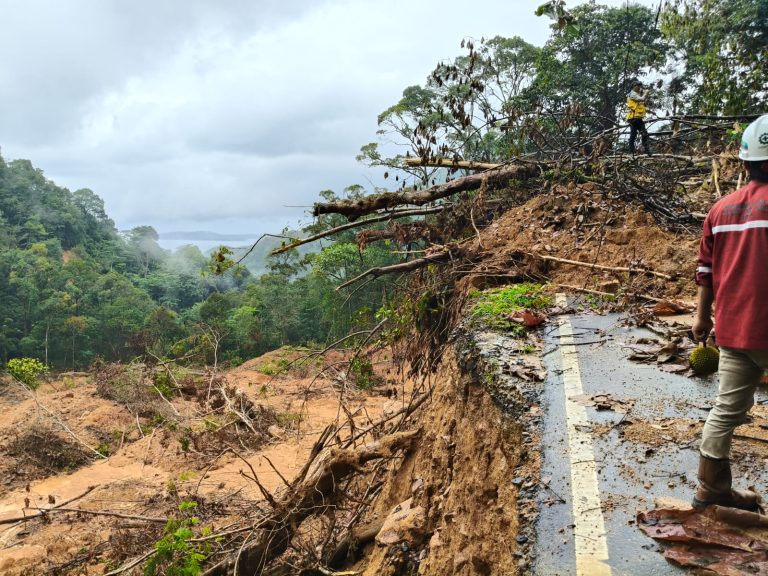
Banner photo: Road buried by landslide in North Tapanuli Regency. 10 December 2025. Source: BNPB