Jakarta — A new trade agreement between Indonesia and the United States has sparked sharp criticism from climate advocates, who warn that a commitment to purchase up to USD 15 billion worth of American fossil fuels could undermine Indonesia’s renewable energy transition.
Firdaus Cahyadi, Program Officer for Natural Resources and Climate Justice at Yayasan Tifa, in a statement on Sunday, February 22, described the agreement as a “major irony.” He said the agreement risks locking Indonesia into long-term fossil fuel dependence at a time when the country is seeking international funding to accelerate its clean energy transition.
“This is a fossil fuel lock-in,” Firdaus said, adding that “on one hand, Indonesia is actively seeking financing for energy transition. On the other hand, the government signs what amounts to an ecological suicide contract by tying itself to the US fossil fuel supply.”
He warned that large-scale fossil fuel import commitments could reduce fiscal and policy space for renewable energy expansion, potentially undermining Indonesia’s Enhanced Nationally Determined Contribution (NDC) targets under the Paris Agreement.
Firdaus also called the deal a form of “energy imperialism,” arguing that Indonesia risks becoming a dumping ground for surplus US fossil fuel production. He urged the government to disclose the full 45-page agreement to the public and establish an independent expert team to audit its potential impact on climate targets.
“Full transparency is essential so that academics and the public can assess the implications,” he said. “The government must at least renegotiate the fossil fuel purchase quota. Indonesia’s energy sovereignty should not be sacrificed for short-term elite interests.”
The billion dollar deal
Under the Agreement on Reciprocal Trade (ART), signed by President Prabowo Subianto and US President Donald Trump in Washington, D.C. on February 19, Indonesia agreed to increase imports of US energy products, including liquefied petroleum gas (LPG), crude oil, refined fuel products, and other commodities.
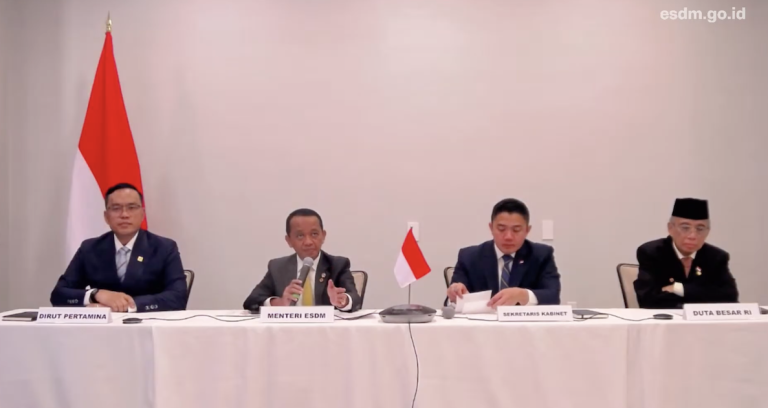
The Ministry of Energy and Mineral Resources (MEMR) said on Friday, February 20, the energy component of the agreement carries an indicative value of up to USD15 billion. The planned purchases include approximately USD 3.5 billion in LPG, USD 4.5 billion in crude oil, and USD 7 billion in refined fuel products, along with other energy commodities such as metallurgical coal and clean coal technology.
Energy Minister Bahlil Lahadalia said the arrangement is aimed at strengthening national energy security amid global market volatility. He stressed that the deal would not increase Indonesia’s overall import volume but would instead shift part of its fuel imports from other regions to the United States.
“We are not increasing the volume of imports. We are reallocating some of our purchases from Southeast Asia, the Middle East, and Africa,” Bahlil said during a press briefing in Washington DC, as cited in the ministry’s statement.
Indonesia-US trade
The controversy unfolds amid broader uncertainty over US trade policy. Antara News reported on Sunday that Coordinating Minister for Economic Affairs Airlangga Hartarto confirmed that the bilateral agreement remains in effect despite a recent US Supreme Court ruling that invalidated a global reciprocal tariff policy introduced by President Trump.
Airlangga told reporters on Saturday in Washington D.C., the Indonesia–US agreement would proceed under the agreed mechanism and would become effective 60 days after signing, pending consultations with relevant institutions in both countries. He noted that while the US had imposed a temporary 10 per cent global tariff for 150 days, the bilateral agreement would continue to be processed separately.
Beyond fossil fuel trade, the ART also includes cooperation on critical minerals supply chains and clean energy technologies. The energy ministry emphasised that Indonesia remains committed to downstream processing of strategic minerals and to expanding bioenergy blending mandates, including plans for E5 bioethanol by 2028 and E10 by 2030.
Indonesia has pledged to peak power sector emissions by 2030 and achieve net-zero emissions by 2060 or sooner. The government is also pursuing international partnerships to finance renewable energy deployment and early coal retirement. (nsh)
Banner photo: The Indonesian Government and the United States Government signed a Reciprocal Trade Agreement (RTA) or Agreement on Reciprocal Trade (ART), which was finalised during a meeting between President Prabowo Subianto and President Donald Trump in Washington DC on Thursday, 19 February 2026. Source: Ministry of Energy and Mineral Resources