Jakarta – Researchers are urging Indonesia to establish a high-accuracy climate data centre to serve as a national alarm system capable of providing early warnings to disaster-prone areas before widespread damage occurs. A specialised climate data centre capable of accurately reading extreme weather changes at the local level is considered essential for predicting increasingly frequent hydrometeorological disasters.
Researcher at the National Research and Innovation Agency (BRIN), Erma Yuli Hastin, assessed that the existing system still mixes disaster modelling and general weather modelling, making it less capable of capturing the dynamics of extreme climate events that occur suddenly. “Indonesia still does not have a climate data centre that is truly dedicated to climate change,” Erma said in a written statement on Friday, 19 December.
He explained that most of the models and tools currently in use are not fully suited to Indonesia’s complex geographical and demographic characteristics, which consist of thousands of islands with many disaster-prone areas. This situation means that risk assessments are often too general and fail to address regional needs promptly.
According to Erma, Indonesia needs to switch to using Earth system models supported by high-performance computing, which is considered a key prerequisite for translating climate data into relevant warnings for the public.
He emphasised that climate data centres specifically designed for climate change must be able to read data with a minimum spatial precision within a radius of one kilometre. With this level of accuracy, early warnings can be tailored to local conditions, rather than simply being regional or national predictions.
“Global models can already predict that Senyar will make landfall with a probability of 90 to 100 per cent,” said Erma, referring to global technology that should be adaptable to the Indonesian context.
Meanwhile, Executive Director of the New Future Disaster Management Centre (NF-DMC) Rizkia Norinayanti emphasised that early warnings of extreme weather will only be effective if they are integrated with a robust preparedness system. She believes that scientific information alone is not enough if it is not translated into concrete action in the field.
“The BMKG provides early warning information, but it does not reach the public. It is the BNPB that operationalises this information into preparedness measures,” said Rizkia.
According to him, the National Disaster Management Agency (BNPB) must have full control over the management and utilisation of the early warning system. This is because the BNPB has a direct mandate to conduct outreach, risk education, and ensure community preparedness in disaster-prone areas.
“BNPB is considered to have the capacity to manage early warning systems, as they are tasked with raising public awareness about disaster preparedness,” he said.
Rizkia also reminded that early warnings would not be effective without an understanding of risk at the community level. Without a clear picture of the threats faced, communities tend to ignore the warnings issued.
“If the public does not understand the risks, warnings will not always be followed by behavioural changes,” said Rizkia. (Hartatik)
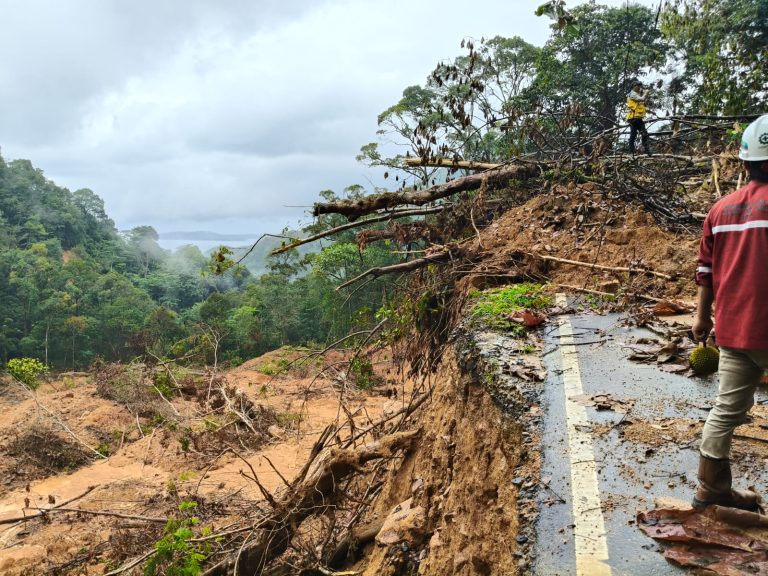
Banner photo: Road buried by landslide in North Tapanuli Regency. 10 December 2025. Source: BNPB