Jakarta – Amidst the ecological crisis affecting Sumatra, the Mining Advocacy Network (JATAM) assesses that North Sumatra Province is now in a state of emergency due to the massive expansion of mining and oil palm plantations encroaching on the remaining forest areas. With concessions piling up in the extractive sector, the province is considered to be “colonised” by the mining and plantation industries, which are accelerating the rate of deforestation and exacerbating the risk of disasters.
The floods and landslides that occurred from late November to early December 2025 resulted in a significant number of casualties. As of 5 December, 836 people were reported dead and 518 others missing. For JATAM, this tragedy cannot be separated from the pattern of environmental destruction that has been going on for decades.
The province of North Sumatra, which spans an area of 7.24 million hectares, is now competing for living space with giant mining and forestry concessions. In the mining sector, two large companies stand out because they operate in sensitive areas: PT Agincourt Resources, which manages the Martabe gold mine, and Dairi Prima Mineral (DPM). Both are located in areas of extremely high ecological value.
JATAM coordinator Melky Nahar explained that Agincourt Resources now controls a concession area of 130,355 hectares under Contract of Work 252.K/30/DJB/2018. This figure represents a dramatic increase compared to the company’s initial permit in 1997.
“According to satellite image analysis using Nusantara Atlas, estimates show that Agincourt’s activities have caused 739 hectares of deforestation over the past year,” Melky said in a statement on Thursday, 11 December.
He added that from 2012 to 2024, the company had recorded a total deforestation of 5,465 hectares in forest areas, not including the clearing of 4,847 hectares in APL areas.
“In addition, the Agincourt concession area overlaps with the Sibual-buali WKP, which is the location of the Sarulla PLTP,” he explained.
In the forestry sector, North Sumatra bears the burden of 13 Forest Utilisation Business Permits, 12 of which are for the timber industry directly linked to deforestation. The total concession area covers 537,131 hectares, not including permits for the use of forest areas for oil palm plantations and mining. PT Toba Pulp Lestari Tbk (TPL) is listed as the holder of the largest concession area, covering 167,912 hectares.
Alfarhat Kasman, from the JATAM Campaign Division, also mentioned the controversial track record of the company owned by tycoon Sukanto Tanoto.
“In 2017, his name was mentioned in the Paradise Papers scandal released by the International Consortium of Investigative Journalists (ICIJ),” said Alfarhat, adding that APRIL Group was accused of funneling billions of US dollars through shell companies in various tax-free jurisdictions.
According to JATAM, forestry industry practices have destroyed 1.6 million hectares of forest in North Sumatra since 2001, with total carbon emissions of 810 MtCO₂e. Mandailing Natal Regency has contributed the most to deforestation, with 170,000 hectares lost.
Melky added that pressure on forests comes not only from timber companies, but also from mining industries that cover the province.
North Sumatra has also become a mining industry colony with 170 mining permits covering the entire province, with a total concession area of 208,423.97 hectares. This is in addition to the geothermal and hydroelectric power plant concessions that require forest clearing for infrastructure, he said.
In addition to large mineral mines such as Martabe, other companies, such as Dairi Prima Mineral, have also contributed to the problem. The zinc and lead mining company lost its environmental permit in June 2025 after the Supreme Court upheld a lawsuit filed by local residents.
JATAM also stated that pressure on the living space of the people of North Sumatra has increased due to palm oil expansion. The total area of palm oil plantations reached 1,175,940 hectares, with deforestation in the last year amounting to 239 hectares, 39 hectares of which were in peat swamp forests. In non-forest areas, land clearing reached 21,554 hectares.
With deforestation rates continuing to rise and the extractive sector dominating the landscape, JATAM asserts that North Sumatra is now at a crisis point. Without spatial planning reforms and clear law enforcement, the province is increasingly vulnerable to even greater ecological disasters in the future. (Hartatik)
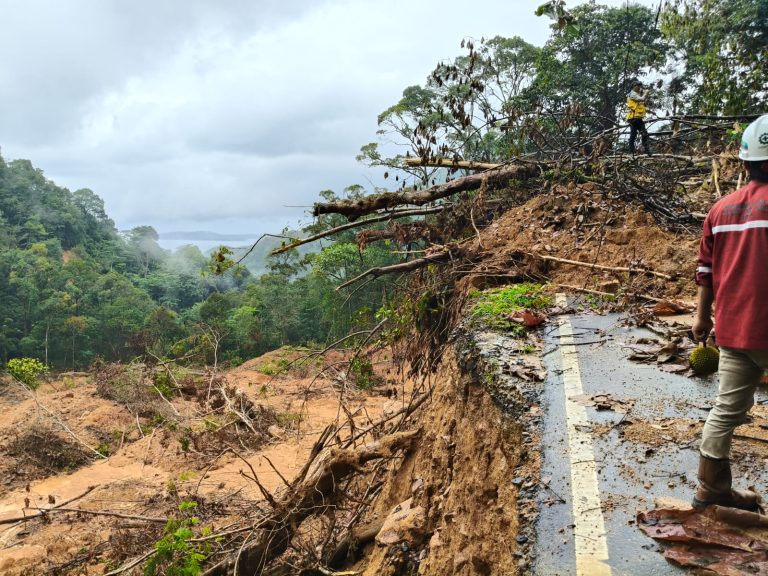
Banner photo: Road buried by landslide in North Tapanuli Regency. 10 December 2025. Source: BNPB